---------------------------------
Address
Phone: +251 988 111 222
Need help or have a question?
Contact us at: info@driveethiopia.com
Addis Ababa, Ethiopia
---------------------------------
Address
Phone: +251 988 111 222
Need help or have a question?
Contact us at: info@driveethiopia.com
Addis Ababa, Ethiopia


Kafa Biosphere Reserve in southwest Ethiopia: what UNESCO protects, how strong the coffee origin claim is, guided walks from Bonga, the road and UK advice.
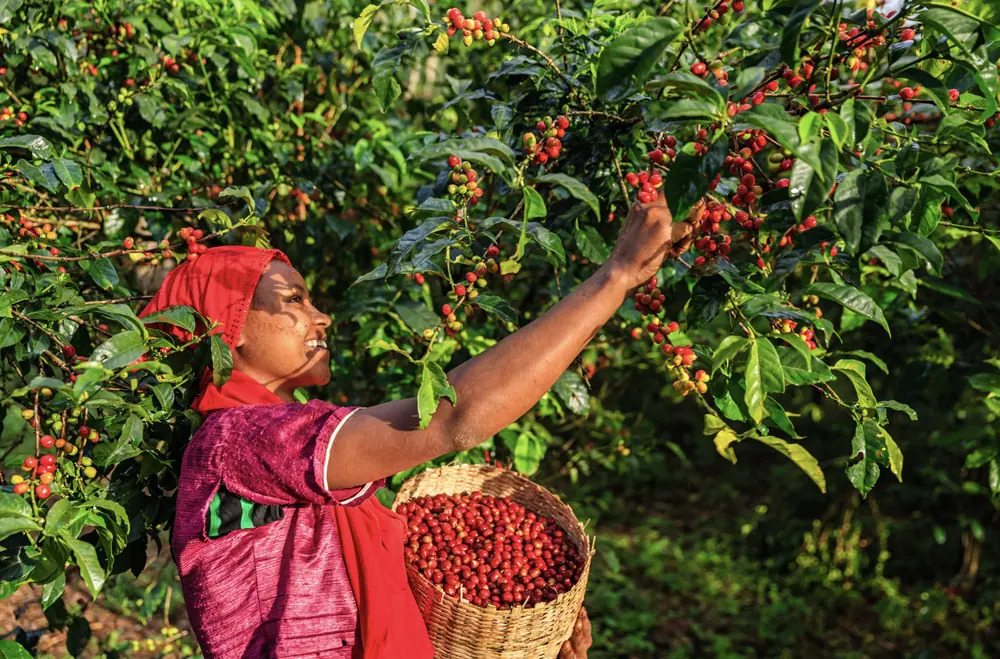
The Kafa Biosphere Reserve is a UNESCO biosphere reserve of 760,144 hectares in the Kafa Zone of southwest Ethiopia, about 460 km from Addis Ababa, with the town of Bonga at its centre. UNESCO recognised it in 2010. Its montane forests still hold wild Coffea arabica, and UNESCO describes the zone as the "centre of origin and genetic diversity" of the species. You visit it on foot, with a local guide, from Bonga. There is no single gate and few signed trails.
In its advice updated on 30 October 2026, the UK government has no warning for the Kafa Zone itself. This guide covers what the reserve is, how strong the coffee origin claim really is, what walking there involves, how to get there and what we could not confirm.
A biosphere reserve is not a national park. UNESCO's Man and the Biosphere programme recognises places where people live and work alongside protected land, and Kafa is one of them. UNESCO's directory gives the reserve a population of 657,780.
So you are not walking into wilderness. You are walking through a lived-in mix of forest, smallholdings, coffee gardens and villages, with protected forest blocks inside it. The Bonga forest forms part of the southern boundary, and the Gewata-Yeba forest, known locally as Boginda, forms part of the northern one. UNESCO notes that the Kafa Zone holds more than half of Ethiopia's remaining montane forest.
That mix is the point of the place. You will see coffee growing under forest canopy, honey and spices gathered from the same trees, and people whose living depends on the forest staying standing. A UN in Ethiopia profile from October 2025 quotes a Kafa coffee farmer: "If we lose our forests, we lose our coffee."
Partly. It depends how precise you want to be.
The well-supported part is that arabica coffee comes from Ethiopia. A genome study published in Nature Genetics in April 2024, led by the University at Buffalo, found that Coffea arabica formed in the forests of Ethiopia through a natural cross between two other coffee species, somewhere between 610,000 and a million years ago. Wild arabica still grows in the southwest's montane forests today.
The claim is that Kafa specifically, rather than the southwest as a whole, is the birthplace. The genome study says "the forests of Ethiopia" and does not name a zone. UNESCO calls Kafa the "birthplace of wild Arabica coffee", but in the same year it also recognised the Yayu Biosphere Reserve, in Illubabor Zone of Oromia, for its montane rainforest "with wild coffee (Coffea arabica) populations".
The claim is also contested inside Ethiopia. In November 2018 The Reporter covered three days of protest in Kafa after a national coffee promotion named Jimma as the origin. People in the Choche area of Jimma Zone make the same claim for themselves.
A fair way to put it: Kafa is one of the places where wild arabica still grows in its original forest, and it has the strongest local and UNESCO backing for the origin story. Treat the single birthplace as tradition, not settled science.
The reserve's forest is montane forest, broken by bamboo stands, wetlands along the rivers and open farmland. Wild coffee grows as an understorey shrub beneath tall trees, which is why it looks so little like a plantation. You often notice it first by the red cherries in season.
The names you will hear most:
Wildlife is there but rarely easy to see in forest. The reserve's records include guereza colobus monkeys, olive baboons and forest birds such as the silvery-cheeked hornbill. If birds are a reason for the trip, our Ethiopia endemic birds checklist shows which species belong to which parts of the country.
Kafa has no entrance gate and no network of marked routes, so it does not work like a national park.
Half-day walks are the usual unit. Longer forest days are possible with a guide, but there is no hut system, so you return to Bonga at night.
Bonga has a National Coffee Museum, built in the town and inaugurated in 2015 according to later press reports. In November 2018 The Reporter described it as still not operating, and we found no dated source since then that confirms regular opening. Do not plan a day around it until it has been checked close to your dates.
Accommodation is in and around Bonga. Community lodge projects have been part of the reserve's ecotourism plans, but we found no dated source confirming that a particular lodge is open now, so we are not naming one here. When we quote a Kafa trip, we confirm the accommodation that is operating for your dates.
We measured the drive on OpenStreetMap through the OSRM router on 9 and 10 November 2026.
| Leg | Distance | Time on a clear road |
|---|---|---|
| Addis Ababa to Jimma | 349 km | About 4 hours 50 minutes |
| Jimma to Bonga | 108 km | About 2 hours 20 minutes |
| Total | 457 km | About 7 hours 10 minutes |
Those times assume an empty road. Our own planning rule is to add 40 per cent for livestock, towns, road works and stops, as our long-distance driving guide explains. That makes the whole trip about 10 hours. With the UK advice against driving after dark outside Addis Ababa, we split it with a night in Jimma, which also puts Jimma's palace and museum on the way.
Jimma has an airport, so you can fly the first leg and drive the last 108 km. Check current Ethiopian Airlines schedules for your dates. Either way, you need a vehicle in Kafa itself to reach the walk starts. Our car with driver service covers the whole southwest run.
Security advice in Ethiopia is regional. This is what the UK Foreign, Commonwealth and Development Office (FCDO) says about the places on the way, from its page updated on 30 October 2026.
| Area | What the FCDO says |
|---|---|
| Central, Southern, Sidama and South West regions (formerly SNNPR) | Advises against all travel "to within 10km of the borders with South Sudan and Kenya including the shores of Lake Turkana". The Kafa Zone is not in that border strip. |
| Gurage zone, Central region | "There has been civil unrest in Gurage zone in the newly formed Central region. A number of incidents have turned violent." The Addis Ababa to Jimma road crosses Gurage zone. |
| Oromia | It reports "increased tensions and violence between armed groups and the security forces across Oromia region, particularly Shewa, Haraghe and Guji zones". |
| Roads outside Addis Ababa | "Avoid driving after dark anywhere outside Addis Ababa." It also suggests travelling in convoy with a second vehicle. |
| Health | It reports "an ongoing outbreak of cholera in the south of Ethiopia", and says malaria is common up to 2,000 metres. |
The FCDO also notes that mobile networks are unreliable and can be shut down without notice, so agree check-in times before you leave signal. Read your own government's advice too, and check with your insurer that the trip is covered. Our Chebera Churchura guide covers the same Jimma road and the park next door to Kafa.
Climate averages for Bonga disagree on totals, but they agree that the driest stretch is around December and January, and that the rest of the year is wet. The 2 November 2026 backpacker guide puts the drier season at November to February and the wettest months at May to September, when, in its words, "rain falls most days".
For walking, December to February is the easier window. The forest is green and worth seeing in the rains too, but expect mud and slower roads.
If you also want to see coffee farms and processing, our coffee farms guide explains the difference between forest, garden and plantation coffee and how Kafa fits into a wider coffee route. For the region beyond the forest, see our Jimma and Kaffa destination page.
In the Kafa Zone of the South West Ethiopia Peoples' Region, about 460 km southwest of Addis Ababa by UNESCO's figure. Bonga is the main town and the base for visits. By our OpenStreetMap measurement the road distance is about 457 km, via Jimma.
Arabica coffee originated in the forests of Ethiopia, according to a 2024 genome study in Nature Genetics. Kafa has the strongest local and UNESCO backing as its birthplace, but the study does not name Kafa, and other southwestern forests such as Yayu also hold wild arabica. Treat it as a well-founded tradition rather than a proven single origin.
Not sensibly. There are few signed trails, and many paths cross farms and villages. A backpacker guide updated in November 2026 recommends arranging a forest guide in Bonga a day ahead. Plan on a local guide for every forest walk.
We would plan at least four from Addis Ababa by road: a day each way, with a night in Jimma, plus two days in Bonga for walks. Flying to Jimma saves most of a day. Adding Jimma's sights or a coffee plantation needs more.
As of 30 October 2026, the UK FCDO has no warning for the Kafa Zone. It advises against all travel within 10 km of the South Sudan and Kenya borders, reports unrest in Gurage zone on the Jimma road, and advises against driving after dark anywhere outside Addis Ababa. Check the latest advice before you go.
December to February, when paths are driest. Climate averages for Bonga put the driest months around December and January, and the long wet season makes forest paths muddy for most of the rest of the year.
Tell us your dates, how many days you have, and whether wild coffee, walking or birds is the main reason to go. We will tell you plainly what we can arrange, what the current advice means for the route, and what is still to be confirmed locally. You will have a reply within two hours and a detailed itinerary with a quote within 24 hours.
