---------------------------------
Address
Phone: +251 988 111 222
Need help or have a question?
Contact us at: info@driveethiopia.com
Addis Ababa, Ethiopia
---------------------------------
Address
Phone: +251 988 111 222
Need help or have a question?
Contact us at: info@driveethiopia.com
Addis Ababa, Ethiopia


Cliff-top Tigray monastery reached only by climbing a rope up sheer rock.
Debre Damo is a sixth-century Ethiopian Orthodox monastery built on the summit of a flat-topped mountain, or amba, in the Tigray region of northern Ethiopia. It is best known for its access: the only way up is to climb a leather rope roughly 15 metres up a sheer rock face. Entry is restricted to men.
Debre Damo is a working monastery perched on an isolated amba (a steep-sided, flat-topped mountain) at around 2,800 metres above sea level in eastern Tigray. Its centrepiece is the church of Abuna Aregawi, one of the oldest surviving buildings in Ethiopia, constructed in the Aksumite style with alternating layers of stone and timber. The monastery holds an important collection of ancient manuscripts, including illuminated gospels, and remains home to a community of monks and deacons. There is no path or stair to the top. Visitors and monks alike ascend a plaited leather rope that hangs down the cliff, with a second safety rope tied around the waist and hauled by a monk above.
Few places pack Ethiopian history, faith and physical drama into one visit the way Debre Damo does. The rope climb is genuinely memorable, and the reward at the top is a quiet plateau with an Aksumite-era church, old manuscripts and long views over the arid Tigrayan landscape. For travellers already exploring Axum and the Gheralta cluster of rock churches, Debre Damo adds a very different kind of monastic site, one that has kept its remote character precisely because it is so hard to reach. It is a place for people drawn to early Christian history and to authentic, still-active religious communities rather than polished tourist attractions.
Tradition holds that Debre Damo was founded in the sixth century by Abuna Aregawi, also written Za-Mikael Aregawi, one of the group of missionaries known as the Nine Saints who spread Christianity across the northern highlands. According to legend, Aregawi was lifted to the summit by a serpent sent by God, which is why the monastery today is reached by a rope rather than a stair. The site grew into one of Ethiopia’s most influential monastic centres, a place of learning and refuge, and its Aksumite-style church is often cited as a rare surviving example of pre-medieval Ethiopian architecture. Over the centuries it accumulated a library of religious texts, some of which are shown to visitors by the monks.
Debre Damo is compact, but there is more to it than the climb. The main things to do include:
The most comfortable time to visit is the dry season, roughly October to March, when the tracks approaching the amba are firm and the rope and rock are dry, which matters for the climb. The main rains fall around June to September and can make the final approach muddy and the ascent slippery. Religious feast days can bring pilgrims and a livelier atmosphere but also crowds at the rope. Confirm any festival dates and current conditions locally before you plan around them.
| Period | What to expect |
|---|---|
| October to March (dry) | Best conditions; dry rock, firm tracks, easiest climb. |
| April to May (hot) | Very warm and dusty but generally dry and accessible. |
| June to September (rains) | Muddy approach and slippery rope; check conditions first. |
Debre Damo lies in far northern Ethiopia, roughly 900 kilometres north of Addis Ababa, close to Adigrat and northeast of Axum near the Eritrean border. Most travellers reach it as part of a wider northern circuit rather than as a standalone trip: a common approach is to fly into the north and then travel overland by hired vehicle, turning off the main Adigrat–Axum road onto a rough track that ends at the base of the amba, where the final stretch is done on foot. A high-clearance vehicle is usually needed for the last section. Exact drive times, road conditions and any domestic flight options change often, so confirm them close to travel.
The site itself takes only a few hours, so most people visit Debre Damo as a half-day or day excursion built into a longer Tigray and Axum itinerary rather than staying overnight nearby. How long you commit depends mainly on how you combine it with Axum, the Gheralta churches and Adigrat.
| Trip type | Suggested time |
|---|---|
| Quick visit | Half a day for the drive, climb and church. |
| Comfortable day trip | One full day paired with a nearby town or site. |
| Part of Tigray circuit | Fits within a 3 to 5 day northern loop. |
There is no tourist lodging on the amba itself, and visitors do not stay overnight at the monastery. Most travellers base themselves in a nearby town such as Adigrat, or in Axum, and visit Debre Damo on a day trip. In Adigrat, Agoro Lodge sits on a hill about 4km south of town in sandstone-built rooms, and Canaan Hotel is a conventional option roughly 34km from the monastery. Axum has the wider choice, led by Yeha Hotel above the stelae field. Standards and rates change frequently, so confirm current options when you book.
Dress modestly and practically: this is an active religious site and a physical climb. Long trousers and covered shoulders are appropriate, and closed shoes with grip make the ascent easier and safer. Bring water, sun protection and a hat for the exposed plateau, plus small birr notes for fees. A head for heights helps; the rope climb is exposed and not suitable for everyone. Leave large or heavy bags below, as anything you carry up must be hauled or worn during the climb.
Debre Damo sits in the Tigray region, which has been affected by conflict in recent years, so security conditions and access can change. Always check your government’s current travel advisory before you travel, and confirm local access with a reputable operator or guide close to your trip: The main physical risk is the rope climb itself, which is exposed and demands basic upper-body strength; the monks provide a safety rope, but the ascent is not appropriate for young children, anyone with limited mobility, or those uneasy with heights. Note also that access is restricted to men. Women are not permitted to climb to the monastery, in keeping with its long-standing monastic tradition, and typically wait at the base.
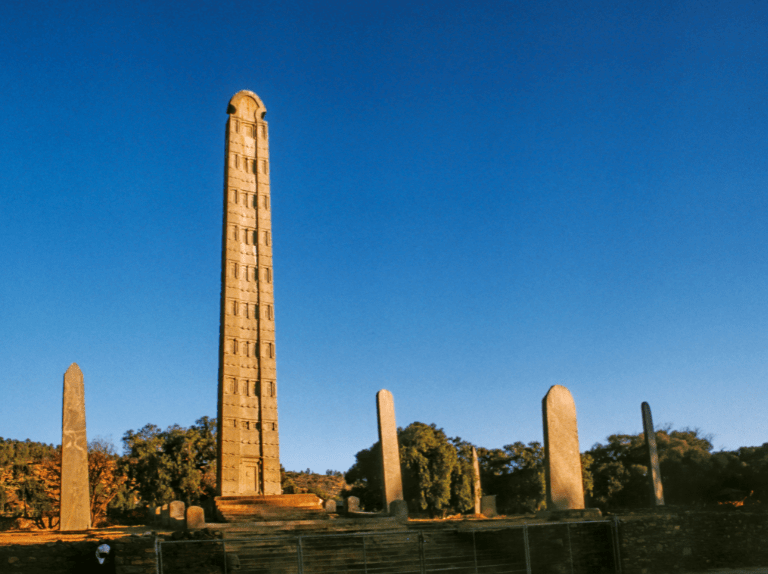
Debre Damo works best combined with other northern highlights. Axum, with its towering ancient stelae and links to the Ark of the Covenant tradition, lies to the west. The Gheralta cluster of cliff-face rock-hewn churches is within reach to the south and offers another dramatic mix of faith and landscape. Adigrat is the nearest sizeable town for services, and the pre-Aksumite temple at Yeha is another option in the area. A typical route strings Axum, Debre Damo and the Gheralta churches into a single Tigray loop, sometimes continuing south toward Lalibela for its famous rock-hewn churches.
The only way up is to climb a leather rope roughly 15 metres up a sheer cliff. A monk secures a second safety rope around your waist and helps haul you from above. There is no path or stair.
No. Access to the monastery is restricted to men, in keeping with its long-standing monastic tradition. Women travellers typically wait at the base of the amba while their group climbs.
Tradition dates its founding to the sixth century, attributed to Abuna Aregawi, one of the Nine Saints. Its church is considered one of the oldest surviving buildings in Ethiopia.
It is exposed and requires basic upper-body strength, but a safety rope is provided. It is not suitable for young children, people with limited mobility, or anyone uncomfortable with heights.
It is in eastern Tigray in far northern Ethiopia, near Adigrat and northeast of Axum, roughly 900 kilometres north of Addis Ababa close to the Eritrean border.
The visit itself takes only a few hours, so most people see it as a half-day or day trip within a wider Tigray and Axum itinerary rather than staying overnight nearby.
It sits in the Tigray region, which has been affected by conflict, so conditions can change. Check your government's current travel advisory and confirm local access with a reputable operator before you travel.
We do not run a scheduled tour to Debre Damo yet. Tell us your dates and we will build one around it.
Ask for an itinerary See all Ethiopia tours → Or rent a car in Ethiopia →
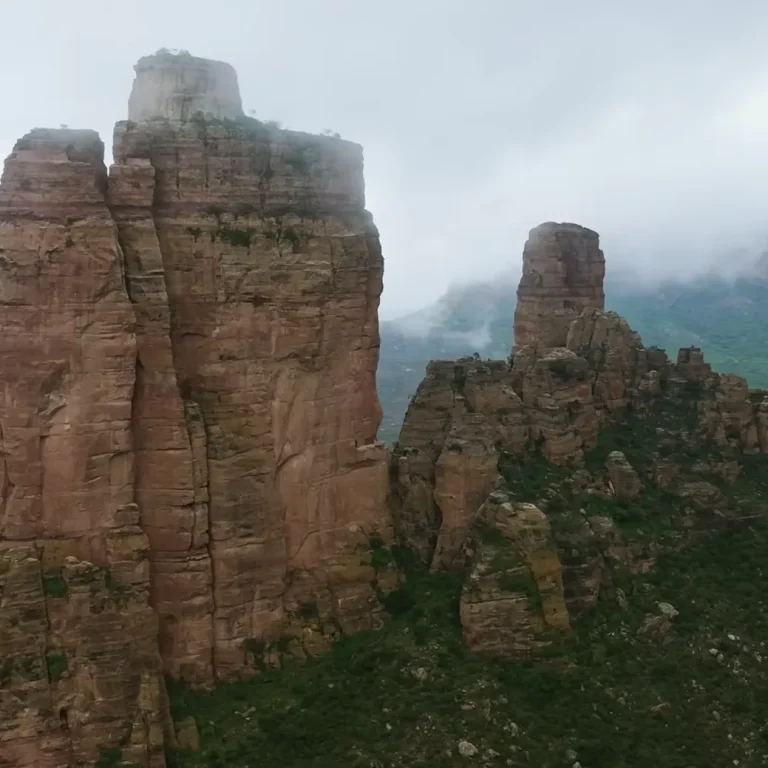
Cliff-top rock-hewn churches and sandstone towers in Ethiopia's Tigray region.
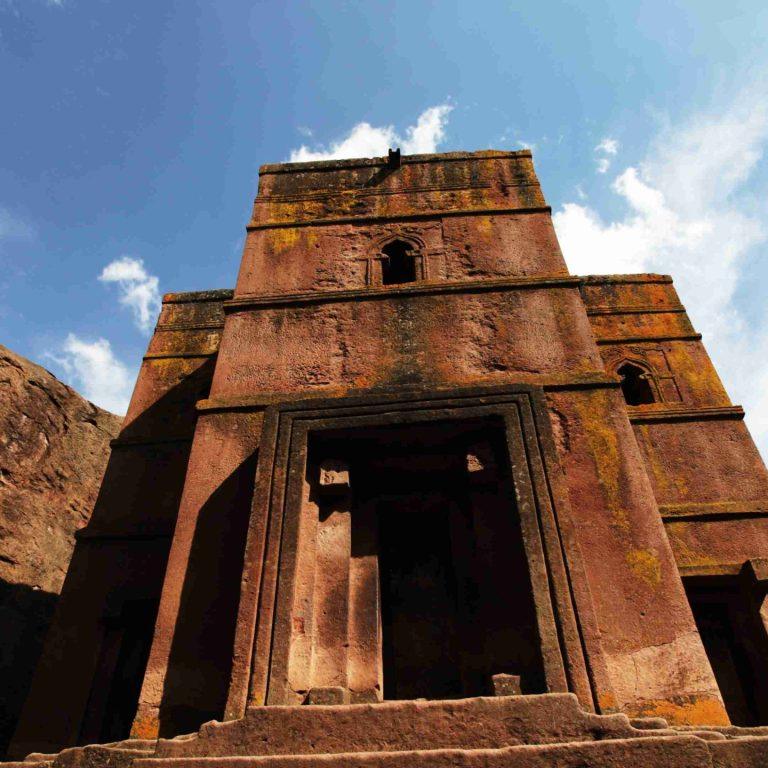
Read More about Gheralta →Ethiopia's holy city of 11 medieval churches carved down into living rock.
Read More about Lalibela →