---------------------------------
Address
Phone: +251 988 111 222
Need help or have a question?
Contact us at: info@driveethiopia.com
Addis Ababa, Ethiopia
---------------------------------
Address
Phone: +251 988 111 222
Need help or have a question?
Contact us at: info@driveethiopia.com
Addis Ababa, Ethiopia


What the Ethiopian Orthodox Church holds about the Ark at Axum, what historians say, the tabot in every church, and whether you can visit.
The Ethiopian Orthodox Tewahedo Church holds that the Ark of the Covenant is in Axum, in a chapel beside the Church of Our Lady Mary of Zion. One monk guards it, he is appointed for life, and nobody else goes in. No visitor has seen it, no scholar has examined it, and the Church has never offered it for examination.
That is the whole of the verifiable position, and it is worth stating plainly at the top because most pages about this either treat the claim as settled fact or write it up as a mystery to be cracked. It is neither. It is a living article of faith, held by millions of people, about an object nobody outside the chapel has looked at.
What follows is what the tradition actually says, what historians say about it, and the thing that gets missed in almost every telling: the Ark is not a curiosity in Ethiopian Christianity. It is the centre of it.
The story is told in the Kebra Nagast, the Ge'ez national epic compiled in its present form in the early fourteenth century, between about 1314 and 1322.
In it, Makeda, the Queen of Sheba, travels to Jerusalem to meet Solomon. She returns to Ethiopia carrying his son, Menelik. Menelik later travels to Jerusalem himself, and when he leaves he brings the Ark with him, either taken or divinely permitted depending on which telling you read. It has been in Ethiopia ever since.
That lineage matters far beyond the object. It is the basis of the Solomonic dynasty, the claim of descent from Solomon that Ethiopian emperors asserted into the twentieth century. Haile Selassie's imperial title rested on it.
The Ark is held to be in a small chapel, the Chapel of the Tablet, built in 1965 on the orders of Emperor Haile Selassie, within the St Mary of Zion complex at Axum.
One monk is its guardian. He is appointed for life, he is the only person permitted to enter, and he does not leave. He prays before it and offers incense. When he dies, a successor is named.
You cannot see inside. Not as a visitor, not as a researcher, not as a head of state. This is not a queue you can join or a fee you can pay, and any operator implying otherwise is selling you something that does not exist.
Here is the thing that makes the Ethiopian relationship with the Ark different from a single contested relic in a single town.
Every Ethiopian Orthodox church holds a tabot. It is a consecrated tablet representing the tablets of the Law that the Ark contained, and it is what makes a building a church rather than a hall. The tabot lives in the innermost sanctuary. Only priests approach it.
At Timkat, the January feast of Epiphany, the tabot is carried out wrapped in cloth, processed through the streets and taken to water. What the crowds are gathered around is not a symbol of the Ark in a loose sense. It is the Ark's presence, understood literally, in every parish in the country.
So the question "is the Ark in Ethiopia" slightly misses the point of how Ethiopian Christianity works. In a real sense the answer the tradition gives is that it is in Axum, and also in every church in the land. Our guide to Ethiopian cultural experiences covers Timkat and what to expect at one.
Scholars are broadly sceptical, and it is worth understanding why rather than just noting that they are.
The Kebra Nagast is fourteenth century. It is a magnificent text and it is roughly 2,300 years later than the events it describes. It was compiled at a moment when the Solomonic line had recently taken power and needed a foundation story, which historians consider relevant.
Nothing has ever been examined. There is no photograph, no measurement, no independent account. Claims of sightings exist and none are verifiable.
Other candidate histories exist for what happened to the Ark after the Babylonian destruction of the Temple, and none commands agreement either.
None of this is a debunking, and it should not be read as one. The tradition is not making a claim that depends on scholarly confirmation, and the people who hold it are not waiting for one. Both things can be reported accurately at the same time, which is what this page is trying to do.
Whatever you conclude about the Ark, the town is one of the most significant archaeological sites in Africa. UNESCO inscribed it in 1980.
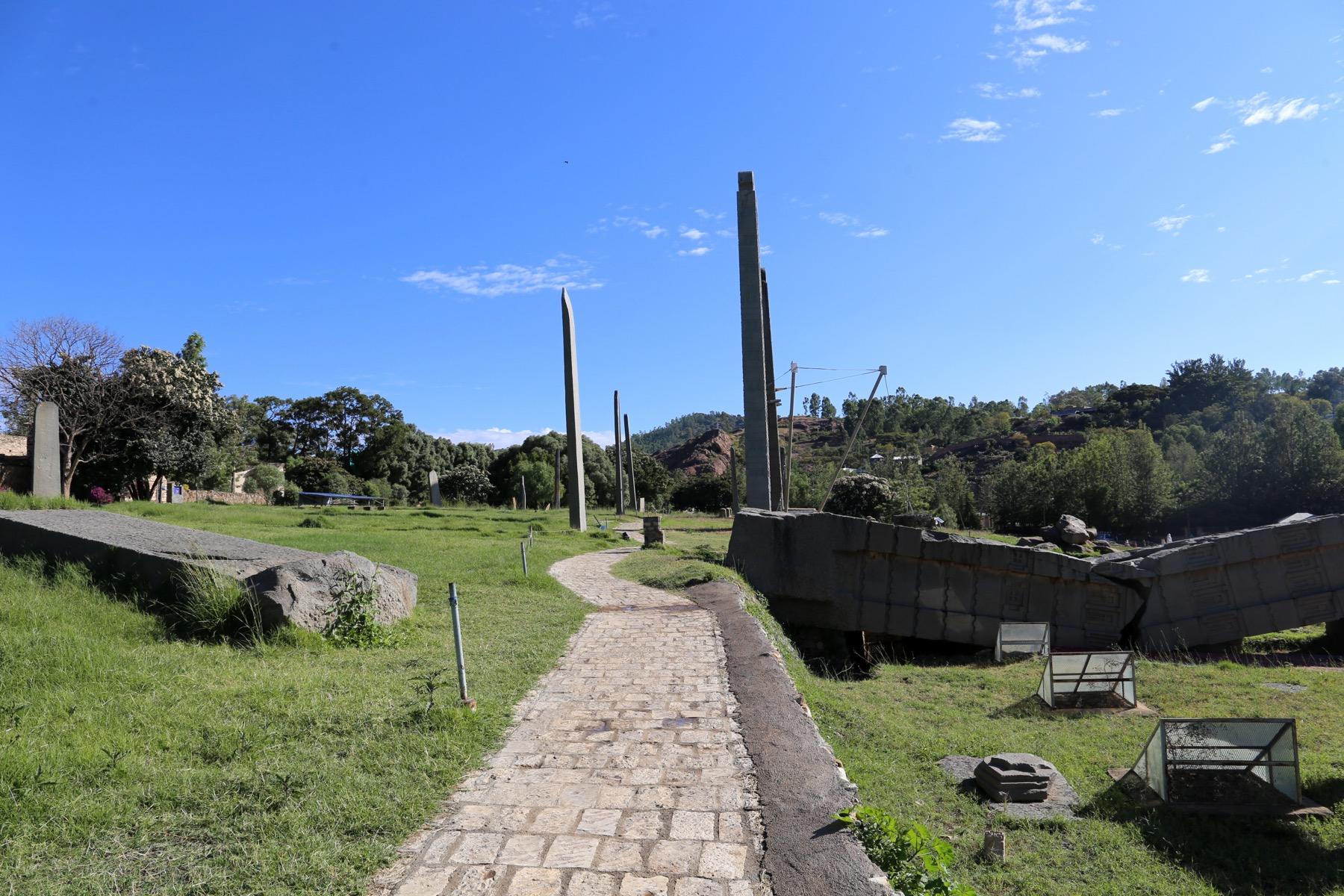
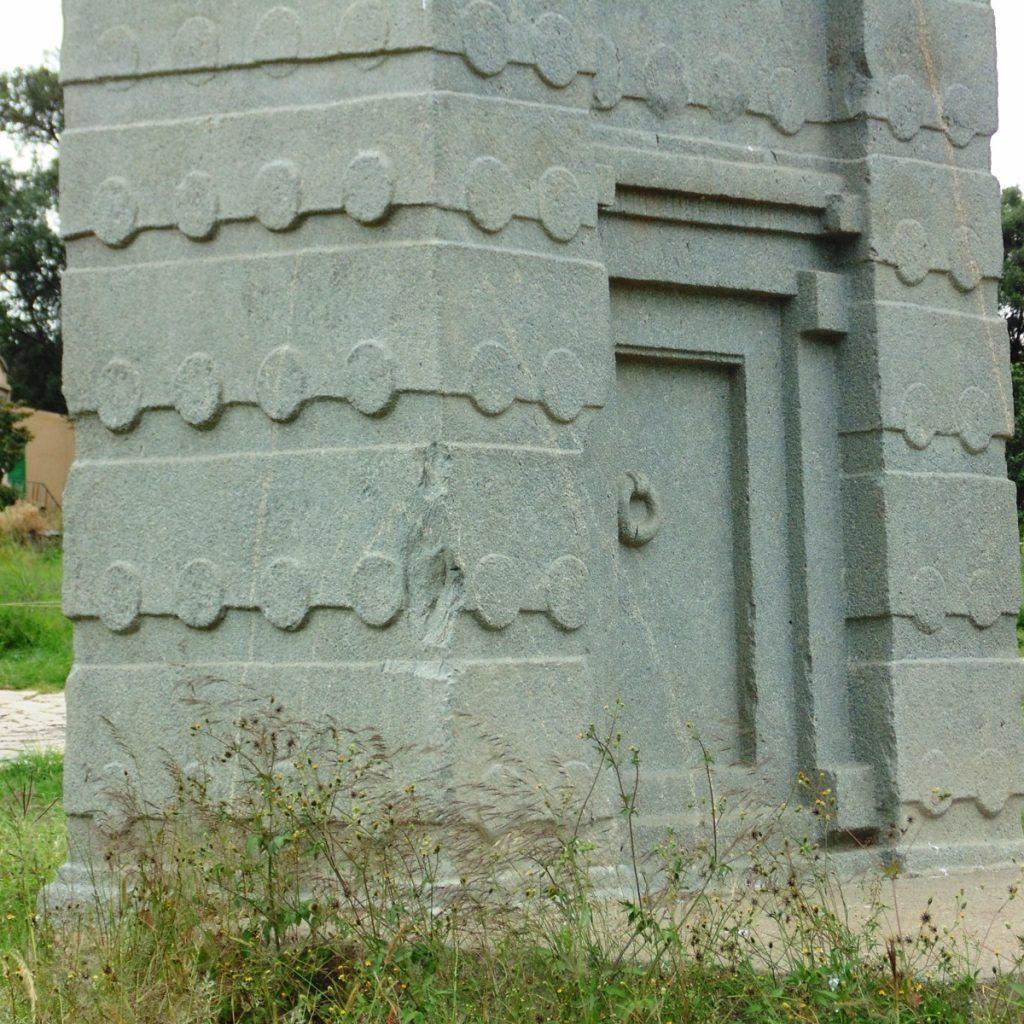
The stelae field is what people come for. These are carved granite monoliths raised as grave markers, cut with false storeys and doors so they read as tall stone buildings.
Ezana is the fourth-century king under whom Aksum adopted Christianity, which makes Ethiopia one of the earliest Christian states anywhere. His tutor Frumentius was consecrated as the first bishop by the Patriarch of Alexandria. Sources place the conversion at various points between roughly 324 and 345, so treat any single date you see quoted with mild suspicion.
There are also rock-cut royal tombs, inscriptions in Ge'ez, Greek and Sabaean, and the ruins traditionally called the Queen of Sheba's palace, though the attribution is traditional rather than established.
The Chapel of the Tablet: no. Nobody enters but the guardian.
St Mary of Zion: there are two churches in the complex, an older one and a twentieth-century cathedral. Access rules differ between them and the older church has traditionally been closed to women. This is the kind of rule that changes and that varies by who is on the gate, so confirm it with your guide on the day rather than relying on any website, including this one.
The stelae field, the tombs and the museum: open, and the substance of a visit.

Axum is in Tigray, and as of the FCDO update on 19 August 2026 the UK Foreign Office advises against all travel to Tigray region.
Our own seven-day northern itinerary does not include Axum, and it is not a leg we currently run. Our ten-day historic route sets out where Axum sits in the classic circuit and flags the same point.
If Axum matters to you, ask us directly rather than assuming the leg is available, and check the current advice for your own government before planning around it. Advisories change in both directions.
Meanwhile the rest of the historic route is unaffected by that specific advisory, and Lalibela carries much of the same religious weight in a place you can currently reach.
Is the Ark of the Covenant in Ethiopia?
The Ethiopian Orthodox Tewahedo Church holds that it is, in the Chapel of the Tablet beside the Church of Our Lady Mary of Zion at Axum. A single monk guards it, appointed for life, and no one else is permitted to enter. It has never been examined or photographed, so the claim can be neither confirmed nor disproven from outside.
Can you see the Ark of the Covenant at Axum?
No. The chapel is closed to everyone except its guardian monk, including researchers and visiting heads of state. You can visit the surrounding St Mary of Zion complex, the stelae field and the museum, but the chapel itself is not open to anybody.
How did the Ark supposedly get to Ethiopia?
The Kebra Nagast, the fourteenth-century Ge'ez epic, tells that Makeda, the Queen of Sheba, visited Solomon in Jerusalem and bore his son Menelik. Menelik later travelled to Jerusalem and returned with the Ark. That descent is also the basis of the Solomonic dynasty claimed by Ethiopian emperors into the twentieth century.
What is a tabot?
A consecrated tablet representing the tablets of the Law held in the Ark. Every Ethiopian Orthodox church has one, kept in the innermost sanctuary and approached only by priests. It is what consecrates the building. At Timkat the tabot is carried out in procession, which is what the crowds are gathered around.
Do historians believe the Ark is in Axum?
Most are sceptical. The Kebra Nagast dates to the early fourteenth century, some 2,300 years after the events it describes, and it was compiled shortly after the Solomonic line took power. Nothing has ever been examined independently. The tradition does not rest on scholarly confirmation and its adherents are not seeking it.
What else is there to see at Axum?
The stelae field, with the fallen Great Stele of about 33 metres, the 24-metre Obelisk of Axum returned from Italy in 2005, and King Ezana's Stele of about 21 metres still standing. Also rock-cut royal tombs, multilingual inscriptions, a museum, and the ruins traditionally called the Queen of Sheba's palace.
When did Ethiopia become Christian?
In the fourth century, under King Ezana of Aksum, which makes it one of the earliest Christian states anywhere. His tutor Frumentius was consecrated first bishop by the Patriarch of Alexandria. Sources place the conversion between roughly 324 and 345.
Is Axum a UNESCO World Heritage Site?
Yes, inscribed in 1980 for its archaeological remains, including the stelae field, the tombs and the ruins of the Aksumite kingdom.
Axum is the one stop on the historic route where availability is a live question rather than a matter of scheduling.
Tell us what you want to see and when and we will tell you plainly what is running and what is not, including when the answer is that a leg is off. We reply within a maximum of two hours, and you will have a detailed itinerary and a quote within 24 hours. Our seven-day northern route covers the part of the circuit that is unaffected.
Feature photograph: the northern stelae field at Aksum, by Sailko, CC BY 3.0.
