---------------------------------
Address
Phone: +251 988 111 222
Need help or have a question?
Contact us at: info@driveethiopia.com
Addis Ababa, Ethiopia
---------------------------------
Address
Phone: +251 988 111 222
Need help or have a question?
Contact us at: info@driveethiopia.com
Addis Ababa, Ethiopia


Where to see Ethiopia's endemic mammals: wolf, mountain nyala, gelada, Walia ibex and more, with parks, altitudes, sighting odds and travel advice.
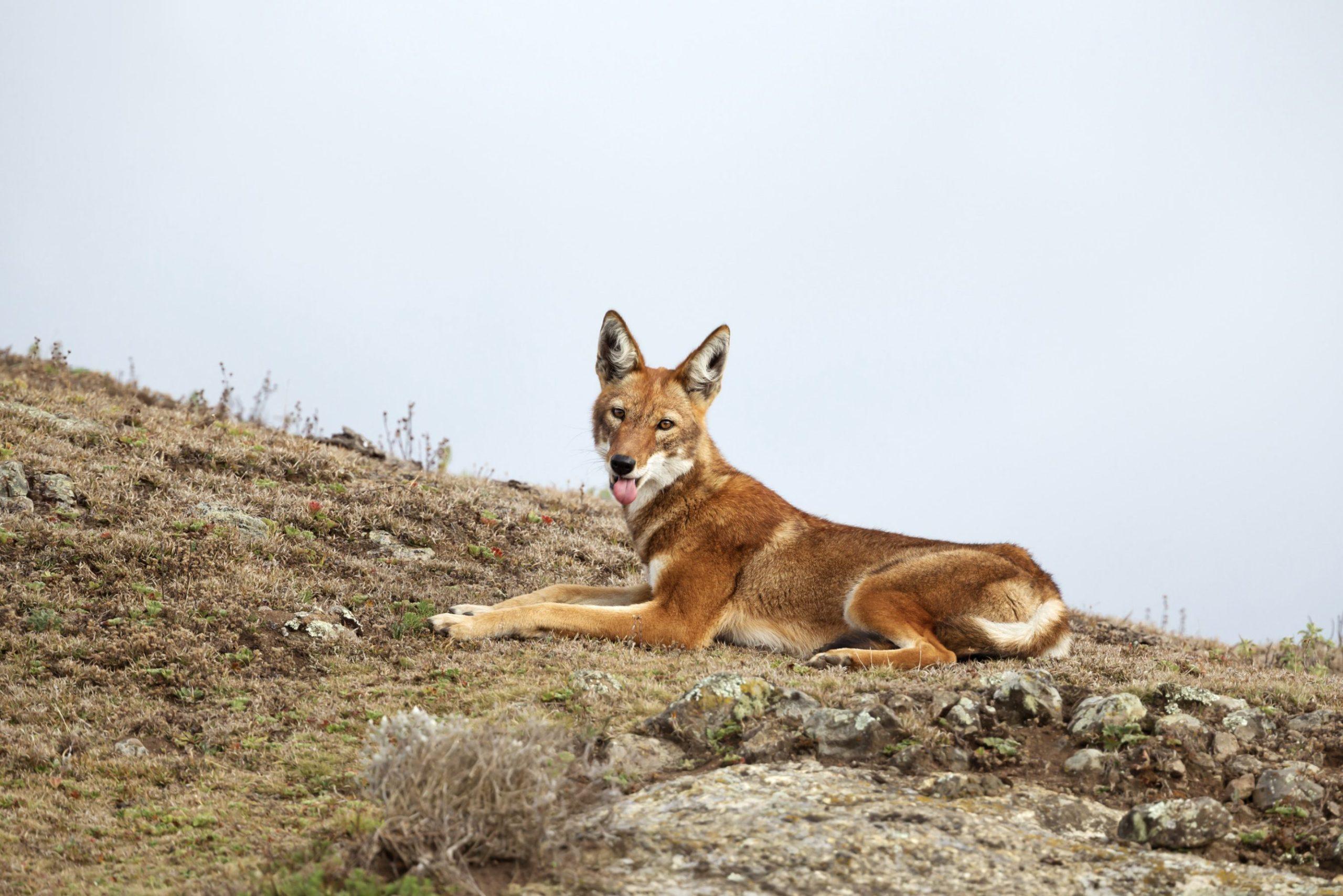
Bale Mountains National Park is the single best place to see Ethiopia's endemic mammals. On one trip there you can look for the Ethiopian wolf, the mountain nyala, Menelik's bushbuck, the giant mole-rat and, with more effort, the Bale monkey. The other two famous endemics, the Walia ibex and the largest gelada populations, live in the Simien Mountains in Amhara region. As of its 30 October 2026 update, the UK Foreign, Commonwealth and Development Office (FCDO) advises against all travel to all of Amhara.
So for now, an endemic mammal trip is a Bale trip. This guide covers each species, where it lives, how hard it is to see, and the current travel advice for each park.
Published totals for Ethiopia's endemic mammals disagree, and we have not found one current official count. Most of the difference comes from taxonomy and from small rodents, shrews and bats that few visitors will ever look for. This guide sticks to the eight animals people actually travel for.
The chance column is our plain-words reading of the sources below. Nobody publishes sighting odds for these animals, so read it as a rough guide only.
| Animal | Red List status | Where to look | Altitude | Chance of seeing | FCDO position, 30 Oct 2026 |
|---|---|---|---|---|---|
| Ethiopian wolf | Endangered | Sanetti Plateau, Bale | Above 4,000 m | Possible on a full plateau day, never certain | No advise-against for Bale zone |
| Mountain nyala | Endangered | Gaysay area near Dinsho, north Bale | Mostly 3,000 to 3,400 m | Good at the right time of day | No advise-against for Bale zone |
| Menelik's bushbuck | Subspecies; no separate listing found | Around Dinsho, Bale | Highland forest | Fair | No advise-against for Bale zone |
| Giant mole-rat | Endangered | Bale Mountains grassland | High grassland | Good, in short glimpses | No advise-against for Bale zone |
| Bale monkey | Vulnerable | Bamboo forest in the Bale Mountains | Bamboo belt | Hard, needs a forest visit | No advise-against for Bale zone |
| Gelada | Least Concern as a species | Simien stronghold; a small Arsi population | 1,800 to 4,400 m | Very good in Simien; hard in Arsi | Simien: against all travel. Arsi: no advise-against |
| Walia ibex | Critically Endangered | Simien Mountains only | 2,500 to 4,500 m | Not plannable now | Against all travel to Amhara |
| Swayne's hartebeest | Endangered (subspecies) | Senkele, Nechisar and Maze | Grassland | Fair to good at the right site | No regional warning names the three sites |
The 2024 estimate from Oxford's Wildlife Conservation Research Unit (WildCRU) puts the population at around 450 wolves in 99 packs, spread across six isolated populations. The Bale Mountains hold more than half of them, and some of the other populations have fewer than 25 adults. The species is listed as Endangered.
Look for wolves on the Sanetti Plateau, above 4,000 m, where a road crosses open Afroalpine moorland. They forage alone, mostly for rodents, even though they live in packs, so a slow drive with frequent stops and scans of the grassland is the usual approach. The main threat to them is disease carried by domestic dogs, which is why guides ask visitors to keep their distance and never feed or approach them.
We cover the wolf in detail, including its numbers, its threats and how to watch it without disturbing it, in our guide to the Ethiopian wolf in the Bale Mountains.
The mountain nyala is Ethiopia's endemic antelope, a large highland antelope. It lives only in the highlands east of the Rift Valley and is listed as Endangered. Its numbers fell from several thousand in the 1960s to a few thousand by the 1980s.
The stronghold is a single area. Up to half of all mountain nyala live in the roughly 200 square kilometres around Gaysay, in the north of Bale Mountains National Park near Dinsho. They usually live between 3,000 and 3,400 m.
Timing matters more than luck. Nyala come out to graze in the morning and late afternoon and shelter in woodland or heather in the middle of the day. They also feed more in overcast or rainy weather.
Menelik's bushbuck, an Ethiopian form of the bushbuck, is also found around Dinsho, so the same area covers both.
The giant mole-rat, also called the big-headed mole-rat, lives only in the Bale Mountains and is listed as Endangered. It is the Ethiopian wolf's main prey.
It is easier to see than its burrowing life suggests. It feeds above ground, reaching out of its tunnel to pull in plants while the lower half of its body stays inside. Each feeding bout lasts about 20 minutes. Watch the grassland near burrow mounds on the plateau and you will usually see a head pop up and vanish. Because mole-rats are what the wolves hunt, mole-rat grassland is also where you scan for wolves.
The Bale monkey is the least known of the group. The 2022 Red List assessment lists the species as Vulnerable and endemic to the Ethiopian highlands east of the Rift Valley, in the Bale Mountains and the Sidamo highlands. The Bale Mountains form of the species is listed as Endangered.
It is a bamboo specialist. A study in Odobullu Forest, published in the journal Oryx, found Bale monkey groups only in bamboo forest, and bamboo is part of what it eats. You have to go into the bamboo to look for it. If it matters to you, tell us when you enquire, because it shapes which forest day goes into the plan.
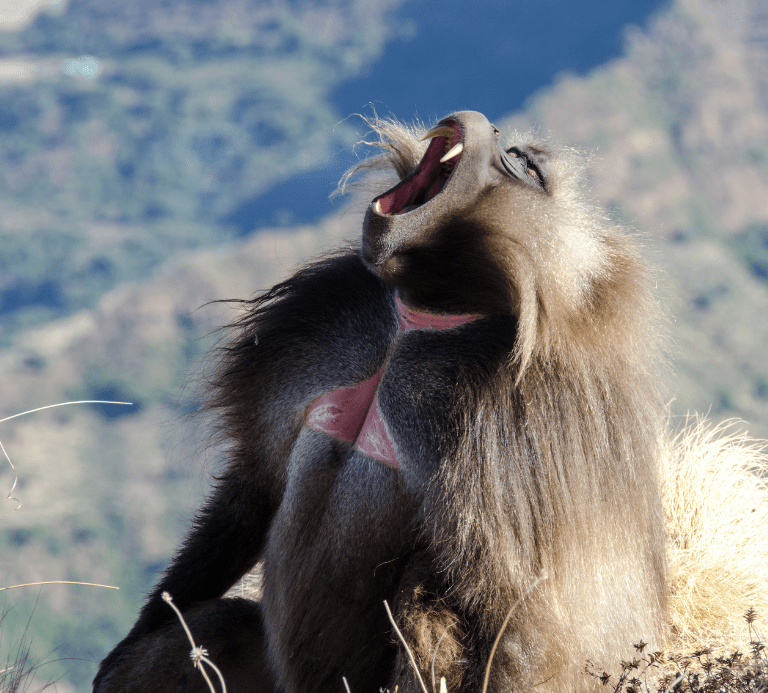
The gelada lives only in the Ethiopian highlands, between about 1,800 and 4,400 m. It is the grazing primate with the bare red patch on its chest. Geladas are active by day. They sleep on cliff ledges, climb up at sunrise to graze on the plateau tops, and return to the cliffs in the evening.
As a species the gelada is listed as Least Concern, though the northern nominate subspecies is listed as Vulnerable. A 2006 survey counted about 4,260 to 4,560 geladas in and around Simien Mountains National Park, the main stronghold. Bradt's 2018 guide notes that many Simien troops are habituated enough to watch at very close range.
That is the gelada most visitors picture, and it is in Amhara. While the FCDO advises against all travel to Amhara, we would not book a Simien trip for you.
There is a gelada south of the Rift Valley too. A separate population was found in 1989 in the Arsi zone of Oromia, in the valleys and forest escarpments of the Robe, Amigna and Bele districts. Researchers describe it as under 1,000 animals in a heavily disturbed area. We found nothing published on visiting them, so plan this as a specialist search with no promise of success.
The Walia ibex is a wild goat with huge curved horns, and it is found nowhere on earth except the Simien Mountains, between about 2,500 and 4,500 m.
Its numbers have crashed. A paper by Paul Scholte and colleagues in Oryx, published online on 21 July 2025, counted 865 ibex in 2015, about 650 across 2019 to 2021, and 306 in 2024, of which 194 were adults. People interviewed for the study blamed poaching, and the authors named the instability of the Covid-19 period and the 2021 to 2022 war as the root cause. They recommended moving the species from Vulnerable to Critically Endangered, and the 2026 Red List assessment now lists it as Critically Endangered.
So the honest answer is that the Walia ibex cannot be part of a trip planned today. The Simien Mountains sit inside Amhara, under FCDO advice against all travel. When that advice changes, our Simien Mountains trekking guide covers the routes. Ibex are most active in the morning and evening and rest on sunny rock ledges in between.
Swayne's hartebeest is a hartebeest that once ranged into Somalia and now survives only in Ethiopia. It is a subspecies, listed as Endangered. The main remaining herds are in the Senkele Swayne's Hartebeest Sanctuary, Nechisar National Park near Arba Minch, and Maze National Park. None of the three is named in the FCDO's regional warnings for Ethiopia.
It is a lowland grassland animal, so it fits a Rift Valley or southern route rather than a Bale highland day.
Awash National Park is often paired with Bale on wildlife trips, but it is not an endemic mammal park. Its headline animals are Beisa oryx, Soemmerring's gazelle and greater and lesser kudu, all of which also live outside Ethiopia. Our Awash National Park guide covers what the park does well.
Check the advice before you include it. Awash lies on the border of East Shewa zone and Afar. The FCDO advises against all but essential travel to all of East Shewa except the expressways, and against all but essential travel to most of Afar. It also reports attacks on vehicles on the A1 road between Adama and Awash.
These are the FCDO's own positions on its 30 October 2026 update. Read them against your own route, and check your own government's advice and your insurer too.
The animals are resident, so they are there all year. What changes is the weather. Our Bale wolf guide recommends October to March. Bale is also less extreme in the main rains than the north: on the Ethiopian Meteorological Institute's 1981 to 2010 averages, Robe in Bale gets 105 mm of rain in July against 280 mm in Addis Ababa. Clear mornings help most with wolves, while nyala feed more on grey, damp days.
Birders and mammal watchers share the same Bale route, so if you want both, our Ethiopia endemic birds checklist shows which birds you will pass on the way.
Both live in the Simien Mountains, so in normal times one trek covers both. As of 30 October 2026 the FCDO advises against all travel to Amhara, where the Simien Mountains are, and we would not book that trip for you while the advice stands. You can look for the small gelada population in Arsi, in Oromia, but the Walia ibex lives nowhere else.
Bale Mountains National Park. It holds more than half of the world's Ethiopian wolves, the main mountain nyala population around Gaysay, Menelik's bushbuck, the giant mole-rat and the Bale monkey.
Around 450 in 99 packs across six isolated populations, on WildCRU's 2024 estimate. More than half live in the Bale Mountains.
Yes. It is listed as Critically Endangered. A 2025 study counted 306 animals in the Simien Mountains in 2024, down from 865 in 2015.
In the north of Bale Mountains National Park, around Gaysay and Dinsho, where up to half of all mountain nyala live. Go in the morning or late afternoon.
October to March is the usual recommendation for Bale. The animals are there all year, but the drier months make the plateau and forest roads easier.
The wolf is never guaranteed, and nobody honest will promise you one. What we can do is put you on the Sanetti Plateau early, at Gaysay when the nyala come out, and in the right forest if the Bale monkey is on your list.
Send us your dates and the animals you most want to see. You will have a reply within two hours and a detailed itinerary with a quote within 24 hours. Start from our Bale Mountains National Park page, our Ethiopia birding and wildlife tour, or a car with a driver for a route built around Bale.
