---------------------------------
Address
Phone: +251 988 111 222
Need help or have a question?
Contact us at: info@driveethiopia.com
Bole, Addis Ababa, Ethiopia
---------------------------------
Address
Phone: +251 988 111 222
Need help or have a question?
Contact us at: info@driveethiopia.com
Bole, Addis Ababa, Ethiopia


Around 121 cliff churches, the largest group of rock-hewn architecture in the world. The climbs, the access rules, and whether you can go.

Tigray holds around 121 rock-hewn churches, the largest group of rock-hewn architecture anywhere in the world. Eighty of them date from the fifth to the fourteenth centuries. They are cut into sandstone towers and cliff faces across the Gheralta range and beyond, and reaching several of them involves climbing rather than walking.
Lalibela is the famous one. Tigray is the older, larger and far less visited one, and the churches here are not sunk into the ground like Lalibela's. They are up in the rock, which is the whole point of them.
One thing to settle first. Tigray is currently under a UK Foreign Office advisory against all travel, and it is not a region we operate in. More on that below. This page is here because people are researching these churches, and the information should be accurate whether or not the trip is available.
These are cliff churches, and the height is deliberate.
Building above the plain put a church beyond casual reach, gave it defensibility, and placed it closer to heaven in a literal architectural argument. Many are invisible from below. You climb, and then there is a door in a rock face.
The Sacred Landscapes of Tigray sit on UNESCO's Tentative List rather than the inscribed World Heritage List. The submission covers eighty of the rock-hewn churches together with some masonry-and-timber churches that are among the oldest surviving timber structures anywhere, from the sixth to tenth centuries.
The one everybody has seen a photograph of, and the reason most people look up Gheralta at all.
The church sits at about 2,580 metres, cut into a sandstone spire. Getting to it involves roughly 800 steps of approach, then a genuinely vertical rock wall climbed on hand and foot holds, then a narrow ledge to the entrance.
The specifics matter here more than the adjectives. The ledge is around 50 centimetres wide. The drop beside it is around 300 metres. The full ascent takes about three hours. And you climb barefoot, because the rock is treated as holy ground and footwear is not permitted.
Inside are painted walls and a domed ceiling in good condition, protected from weather by the rock itself for centuries.
This is not a walk with a view at the end. If you have a serious problem with heights, this is the wrong church, and there is no shame in stopping at the base. Local guides help with the holds and there is rope assistance in places, but it remains an exposed climb on bare feet.
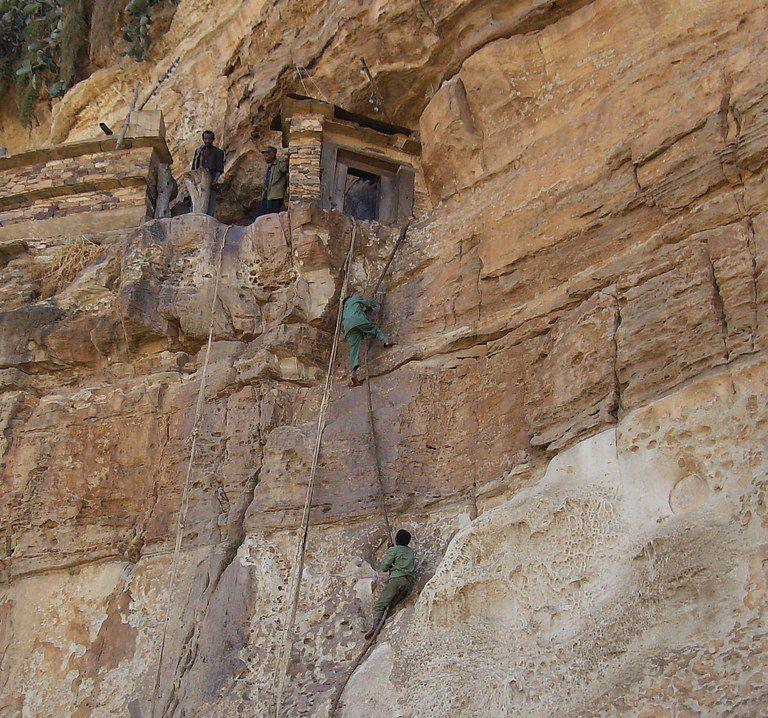
A different kind of inaccessible.
Debre Damo sits on a flat-topped amba, a sheer-sided rock plateau, and the only way up is a plaited leather rope. A monk at the top lowers it, you tie it around your waist, and you are pulled up the cliff face.
Debre Damo admits men only. Women are not permitted, and the prohibition extends to female animals. Women visiting the site stay below the cliff. This is a rule of the monastery rather than a guideline, and it is not going to be waived, so plan around it rather than arriving to find out.
The monastery is ancient and holds manuscripts and a timber-and-stone church of the kind the Tentative List submission describes.
Beyond Abuna Yemata, the Gheralta range holds a spread of churches at varying levels of difficulty, and this is where a trip here actually happens.
Maryam Korkor is a large church with painted domes, reached by a long uphill walk and a moderate scramble rather than a climb.
Daniel Korkor is a small chapel a short walk further along the ridge from Maryam Korkor, with a startling position and a fraction of the exposure of Abuna Yemata.
Together those two make the sensible day for most visitors: real cliff-church atmosphere, genuine effort, and nothing that requires bare feet over a 300 metre drop.
| Church | Effort | Exposure |
|---|---|---|
| Abuna Yemata Guh | About three hours up. Vertical rock wall on hand and foot holds, barefoot | Severe. A 50 cm ledge above roughly 300 m |
| Maryam Korkor | Long uphill walk with a moderate scramble | Moderate |
| Daniel Korkor | Short walk on from Maryam Korkor | Mild, with a narrow section |
| Debre Damo | Hauled up a cliff on a leather rope | High, and men only |
There is no technical climbing gear involved anywhere on this list, which is exactly why the exposure is worth taking seriously rather than dismissing. The risk is not difficulty, it is consequence.
Go with a local guide in every case. They know the holds, they carry what you should not, and at Abuna Yemata they are the difference between a hard climb and a bad idea.
These sites were damaged during the conflict in northern Ethiopia, and the churches have been the subject of active concern about looting, shelling damage and the loss of manuscripts. Anyone planning a visit should expect the picture on the ground to differ from older guidebooks and travel writing.
That is a further reason to take current local advice rather than a page like this one as the last word.
As of the FCDO update on 19 August 2026, the UK Foreign Office advises against all travel to Tigray region. Gheralta, Abuna Yemata Guh and Debre Damo all sit inside it.
We do not run trips to Tigray, and our northern itineraries route around it. Our seven-day historic route covers Bahir Dar, Gondar, the Simien and Lalibela without entering Tigray, and our ten-day version sets out where Tigray would sit if it were available.
Check your own government's current advice before planning anything around this region, and ask us directly rather than assuming a leg is running. Advisories move in both directions.
If what draws you is rock-hewn churches rather than Tigray specifically, Lalibela is reachable now and holds eleven of them, and Yemrehanna Kristos near Lalibela is a built cave church that is a genuine counterpart to the Tigray timber-and-stone tradition.
How many rock-hewn churches are there in Tigray?
Around 121, which is believed to be the single largest group of rock-hewn architecture in the world. Eighty of them, dating from the fifth to the fourteenth centuries, form part of the Sacred Landscapes of Tigray submission on UNESCO's Tentative List, alongside some of the oldest surviving timber structures anywhere.
How hard is the climb to Abuna Yemata Guh?
Hard, and exposed. Roughly 800 steps of approach, then a vertical rock wall climbed on hand and foot holds, then a ledge around 50 centimetres wide above a drop of roughly 300 metres. The ascent takes about three hours and is done barefoot, because the rock is treated as holy ground.
Do you have to climb barefoot at Abuna Yemata Guh?
Yes. Footwear is not permitted on the rock, which is considered holy ground, so the climb is made on bare feet. Local guides assist with the holds and there is rope help in places, but there is no technical climbing equipment.
Can women visit Debre Damo?
No. Debre Damo admits men only, and the prohibition extends to female animals. Women stay below the cliff. It is a monastery rule rather than a guideline and it will not be waived, so it is worth knowing before you travel rather than on arrival.
How do you get into Debre Damo?
You are hauled up the cliff on a plaited leather rope. A monk at the top lowers it, you tie it around your waist, and you climb the rock face with it. There is no path and no steps.
Is Gheralta safe to visit?
Gheralta is in Tigray, and as of the FCDO update on 19 August 2026 the UK Foreign Office advises against all travel to Tigray region. Separately, the churches themselves involve genuinely exposed climbing. We do not currently operate in Tigray. Check your own government's current advice before planning.
Were the Tigray churches damaged in the conflict?
The churches were the subject of serious concern during the conflict in northern Ethiopia, including damage and losses of manuscripts. The condition of individual sites may differ from older guidebooks, which is a further reason to take current local information rather than published accounts.
What is the difference between Lalibela and the Tigray churches?
Lalibela's eleven churches are cut downward into the ground and stand in excavated pits. The Tigray churches are cut into cliff faces and sandstone towers, often high above the plain, so reaching them involves climbing. Tigray has far more of them and they are older, but Lalibela is far more accessible and is currently reachable.
Tigray is the one region where the honest answer is often that a trip is not available, and we would rather tell you that than sell you around it.
Tell us what draws you and we will tell you plainly whether it can be done and, if not, what comes closest. We reply within a maximum of two hours, and you will have a detailed itinerary and a quote within 24 hours. Our northern historic route is the circuit we do run.
