---------------------------------
Address
Phone: +251 988 111 222
Need help or have a question?
Contact us at: info@driveethiopia.com
Bole, Addis Ababa, Ethiopia
---------------------------------
Address
Phone: +251 988 111 222
Need help or have a question?
Contact us at: info@driveethiopia.com
Bole, Addis Ababa, Ethiopia


The hyena feeding explained honestly, the walled old town with its 82 mosques, and the drive up from Dire Dawa answered directly.
Every evening, outside the walls of Harar, men feed wild spotted hyenas by hand. They call them by name, hold strips of raw meat out on sticks and sometimes in their teeth, and the hyenas come in off the hill to take it. This is not a show built for visitors. It started as a way of keeping hyenas off livestock, and it has been going long enough that the animals and the families both know the routine.
Harar itself is the older story. Jugol, the walled old town, holds 82 mosques and 102 shrines inside about a square kilometre, and UNESCO inscribed it in 2006.
If you have come here from a search about the drive, the short answer is at the bottom: Dire Dawa to Harar is roughly 50 km and about an hour, and it climbs the whole way.
Two families hold the tradition, working at separate sites outside the walls, and they go out after dark every night.
Where it came from. Spotted hyenas live on the hills around Harar and have always come close to town. Feeding them was a practical arrangement: a fed hyena is not taking your goat. Over generations that hardened into something closer to a relationship, with individual animals named and recognised.
What Hararis say about them. Hyenas are widely regarded as useful rather than vermin, cleaning waste from the edges of the city, and in local belief protecting it from harm. That is a different starting point from how hyenas are seen almost everywhere else.
What it is now. It is also a paid attraction. Visitors pay to watch, and you will be offered the stick to hold yourself. That is worth knowing in advance rather than discovering at the moment somebody hands you meat.
Be straight with yourself about the animals. These are wild spotted hyenas, not tame ones. They have the strongest bite of any land carnivore of their size. The men doing this know the individuals and you do not, so if you take the stick, do exactly what you are told and nothing else.
Go with someone who can introduce you rather than turning up alone, and do not photograph with flash.

The Jugol wall was raised between roughly the thirteenth and sixteenth centuries. It runs about 3.5 km, stands around 5 metres high, and it still defines the old town rather than sitting in it as a ruin.
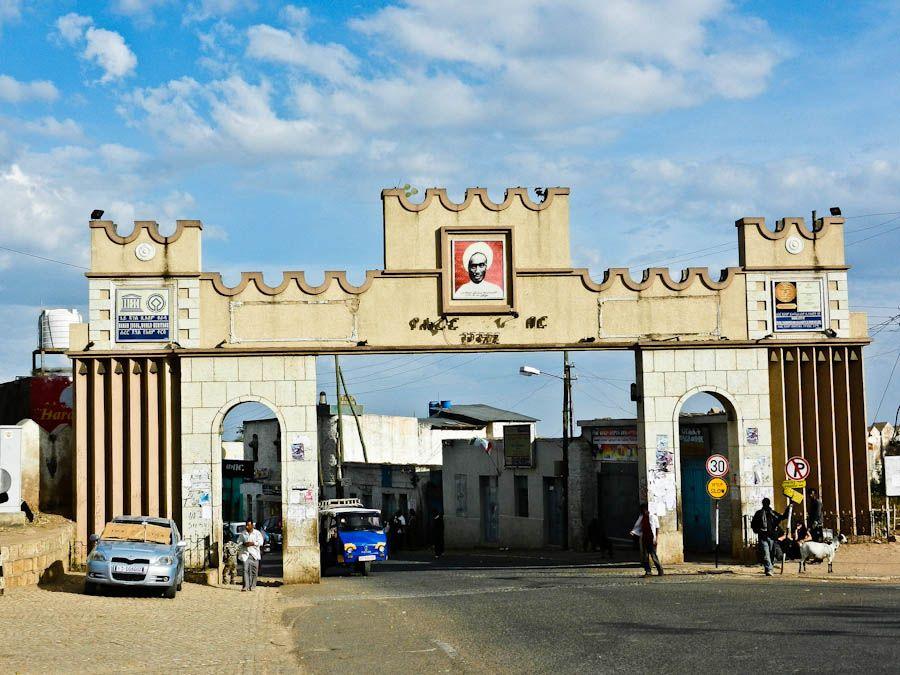
Five original gates pierce it: Shoa, Buda, Erer, Sanga and Fallana. A sixth, the Harar Gate, was cut in 1889 under Ras Makonnen to let vehicles through, and that is the one most visitors arrive by.
Inside is one of the densest religious landscapes anywhere: 82 mosques, three of which are held to date from the tenth century, and 102 shrines, in a walled area of about a square kilometre. The lanes are narrow, largely unmarked, and genuinely easy to get lost in, which is part of the pleasure and the reason to have a guide.
The houses are the underrated part. The traditional Harari house has a raised, tiered reception room, walls hung with baskets and painted dishes, and a layout that reads as one continuous piece of design. Several are open to visitors.
Arthur Rimbaud stopped writing poetry at twenty and spent much of the rest of his short life in Harar as a trader. That fact is stranger than anything invented about the place.
The building shown as Rimbaud House is a handsome nineteenth-century merchant's house with painted ceilings and an upper gallery, and it holds a photographic collection of old Harar that is worth the entry on its own. Whether Rimbaud lived in this specific building is disputed, and the museum is upfront about it. Go for the photographs and the architecture, not for the association.
This is the practical question people actually search, so here it is directly.
| Distance | Roughly 50 km. Published figures vary between about 42 and 55 km depending on the route measured |
| Driving time | About an hour in normal conditions |
| The road | Surfaced, winding, and a steady climb |
| Altitude change | Dire Dawa sits low and hot. Harar is well above it and noticeably cooler |
Dire Dawa has the airport. That is the reason the two towns appear together on itineraries and the reason our tour covers both. You fly into Dire Dawa and drive up to Harar, which is why the Harar and Dire Dawa tour is built the way it is.
The climb is the thing to expect. You leave a hot, low, modern railway town and arrive an hour later in a cool walled city that feels several centuries and several hundred metres removed, because it is both.
One full day inside Jugol covers the gates, several mosques and shrines from the outside, a Harari house, the market and Rimbaud House.
Plus one evening for the hyenas, which happens after dark and is not something you can bring forward.
So: two nights is the honest minimum, arriving on day one, a full day in the old town, the hyenas that evening, and out on day three. Doing it as a single day trip from Dire Dawa means skipping either the old town or the hyenas.
Dress conservatively. Harar is a working Muslim city and Jugol is a residential quarter, not an open-air museum. Shoulders and knees covered.
Ask before photographing people. Especially at the market, and especially of women.
Most mosques are not open to non-Muslims. You will see them from outside, which is the norm here and not a slight.
Take a guide inside the walls. The lanes are a maze, much is unlabelled, and a guide is also what turns a shrine you would walk past into something explained.
Carry small notes. Entry to houses and the museum is cash.
How far is Harar from Dire Dawa?
Roughly 50 km, and about an hour by road. Published distances vary between about 42 and 55 km depending on the route measured. The road is surfaced and climbs steadily, so Harar is noticeably cooler than Dire Dawa when you arrive.
Is the hyena feeding in Harar real or staged for tourists?
Both, and the order matters. It began as a practical way of keeping hyenas off livestock and has been practised for generations by particular families, who know individual animals by name. It is now also a paid attraction that visitors watch and can take part in. The hyenas are genuinely wild.
Is it safe to feed the hyenas at Harar?
They are wild spotted hyenas with an extremely powerful bite, so treat it seriously. The men who run it know the individual animals and manage the interaction. If you take the stick, follow their instructions exactly, do not use flash, and do not approach the animals on your own initiative.
What is Harar Jugol?
The walled old town of Harar, inscribed by UNESCO in 2006. The wall runs about 3.5 km and stands around 5 metres high, and it encloses roughly a square kilometre containing 82 mosques and 102 shrines, along with traditional Harari houses and a dense maze of lanes.
How many gates does Harar have?
Five original gates, Shoa, Buda, Erer, Sanga and Fallana, plus a sixth cut in 1889 under Ras Makonnen to allow vehicles in. That sixth, the Harar Gate, is the one most visitors arrive through.
Did Arthur Rimbaud live in Harar?
He lived in Harar as a trader for much of his later life, having given up poetry in his early twenties. Whether he lived in the building now shown as Rimbaud House is disputed, and the museum says so. It is worth visiting for the architecture and its collection of historic photographs of the city.
How many days do you need in Harar?
Two nights. A full day covers Jugol, the market, a Harari house and Rimbaud House, and the hyena feeding happens after dark, so a single day trip from Dire Dawa forces you to drop one or the other.
When is the hyena feeding in Harar?
After dark, every evening, at sites outside the city walls. It is not scheduled around visitors, so build your evening around it rather than expecting it to move.
Harar sits east, away from the northern historic circuit and the southern loop, which is exactly why it stays quiet and why it needs planning into a trip rather than bolting on.
Tell us your dates and how long you have and we will tell you whether it fits. We reply within a maximum of two hours, and you will have a detailed itinerary and a quote within 24 hours. Our Harar and Dire Dawa tour is the version we run.
